


The Best and Most Navigable Subway Systems in the World, Ranked


I’ve taken metros in cities around the world. Some made getting from Point A to Point B feel like a breeze. It was a smooth ride through tunnels. In other cities, a simple transfer felt like a word problem on the SAT and left me questioning my life choices . At some point, after many platforms, transfer corridors, and escalators, I stopped judging a system by its size or fame. Instead, I began to judge it by something simpler:
How much of my day did it take from me?
Here are my picks for the best subway systems in the world. I'd love to hear your thoughts! Any I missed? Do you disagree with my rankings? Leave your thoughts in the comments!
1. London Underground: My Top Pick for Best Subway System

London's Underground is large, layered, and truly underground. You go so deep that you might wonder if you’ve gone through different layers of the geological strata. Two escalators, a long corridor, one more escalator, and then a final staircase that feels almost ceremonial. There are stations where daylight becomes a memory — not gone, but theoretical.
And yet, once you’re down:
the colors honor their intent,
the transfers feel like continuation, not punishment,
the map becomes not metaphor, but fact.
There is something profoundly steady about the Tube. It doesn’t hustle you, it doesn’t withhold clarity, it doesn’t perform cleverness for the sake of it. It is old, yes. It is drafty in places. But its logic is deeply human.
You never feel toyed with, you feel carried — even three escalators beneath London soil.
Travel Note: This megacity has an easy transit system for visitors. The signs and maps are clear, so even first-timers can learn quickly.
2. Tokyo Metro: If London is clarity, Tokyo is composure.
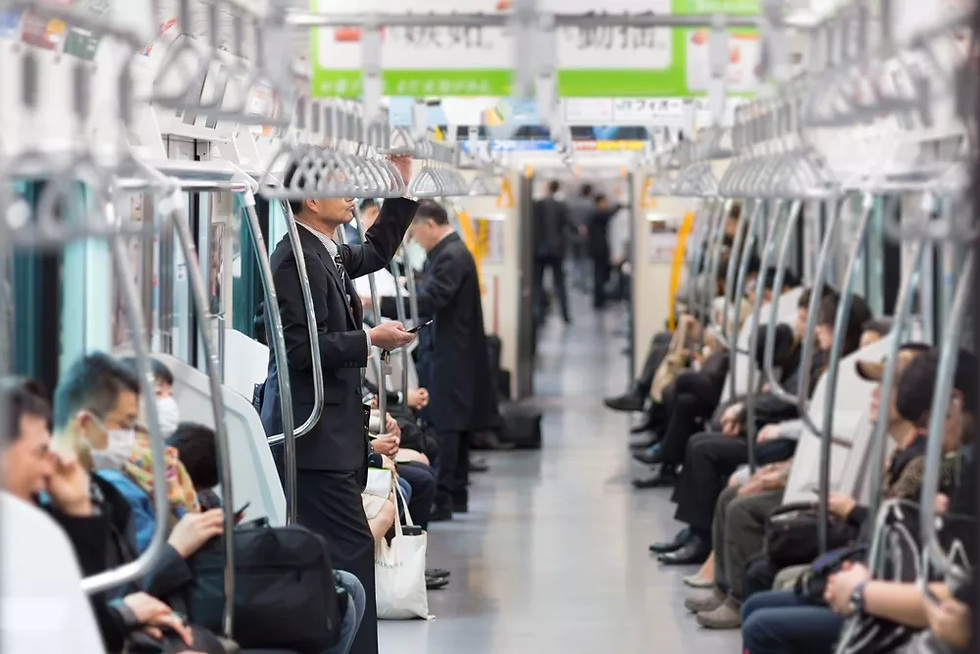
Even in the crush of Shinjuku or Ginza at 18:00, there is a gentleness in the way people move — a quiet alignment of purpose that never feels like crowding. The signage glows rather than shouts, announcements land evenly, and each platform feels like a study in controlled motion.
There is color — but never clutter. Volume — but never escalation.
Tokyo has one of the busiest rush hours in the world. But, it feels like a librarian reminding you that your book is waiting. You do not tense in Tokyo. You adjust your stride and trust that the city is designed to absorb you.
Travel Note: Nearly frictionless even during rush hour; pay attention to car designations for boarding queues and women-only sections.
3. Paris Métro: Where Getting Lost Still Feels Chic

Paris is not subtle underground. It arrives with tempo.
Tile walls, brass railings, the faint scent of baguette and brake dust, and that unmistakable hush of expectation on Line 1 at evening peak. People walk diagonally — always diagonally — as if the shortest distance between two points must contain a gesture.
Day one? You feel overwhelmed. Day two, you feel a bit more confident but keep the map clutched tightly in your hand. By day three, you've figured out how to turn your shoulders and move diagonally along with the crowd with the confidence of a local.
Even when crowded, even when rapid, the Métro never loses its sense of style. It moves with the assurance of a city long practiced in being observed.
Travel Note: Lines are frequent and fast; keep right on escalators unless you intend to keep pace with the Parisian ascent.
4. New York City Subway: Raw, Relentless, and Utterly Itself

New York does not curate its underground experience — it declares it.
Mosaic fragments from 1910, hot wind rising from tracks in August, the unapologetic screech of brakes, a saxophone spilling melody into a car with fluorescent lighting.
There is no soft arrival. There is motion: continuous, democratic, occasionally off-key, always awake. New York is not shy with its edges. But if you lean into them — the express train thunder, the 2 a.m. platform sermon, the mango vendor at 10 p.m. — you ride the city exactly as it is.
Raw, reachable, restless.
Travel Note: Expect reach, not calm; express vs. local is your only true test of comprehension.
5. Chicago ‘L’: The City Stays in Frame

Chicago is elevated honesty.
Open platforms in winter wind, steel bends over the river, skyline angles visible between girders and glass. The city stays with you while you move — not as wallpaper but as vantage.
There is no dramatic descent, no architectural theater. Just a rhythmic sound and a familiar sight of brick, bridge, and rooftop. It feels like the system wants you to stay connected to the place you are passing through.
You see Chicago while traveling through it. Not every city allows that.
Travel Note: The ‘L’ is straightforward; choose it when your route mirrors the grid, and enjoy the cityscape on the way.
6. Copenhagen Metro: Minimalism as Mercy

In Copenhagen, a metro ride feels like a long, measured breath.
Trains arrive smoothly, doors open without stress, and the map is simple. It feels like someone finally respected our attention span.
Minimalism isn’t aesthetic here — it’s emotional architecture. You move, quietly, and remain whole.
Travel Note: Airport-to-city transfers are some of the smoothest in Europe; signage remains mercifully sparse but accurate.
7. Munich U-Bahn: Precision Without Pressure

Munich takes its time to understand things. Once it does, the system shows itself to be steady and precise, in a typical Bavarian way.
Soft tiles and well-sized platforms create a welcoming feel. The timetable shows that being on time is a courtesy, not a pressure.
Munich doesn’t aspire to spectacle. It aspires to functionality with grace.
You don’t conquer Munich’s network. You assimilate into it — steadily, politely, on time.
Travel Note: Ticketing is simple but check zones; Munich rewards the traveler who honors timetables.
8. Madrid Metro: Warmth at Transit Speed

Madrid offers warmth without insistence.
Clean lines, golden tiles, a calm vibrancy in the stations that feels less like transit and more like procession. The airport line rolls in with a soft practicality: no theatrics, no gauntlet, just arrival.
You feel guided, not managed.
Madrid never demands performance from its riders — only presence.
Travel Note: Among Europe’s best values; tap-in fares make short hops easier than walking in afternoon heat.
Subway Systems That Ask a Bit More of Your Spirit

Some cities build metros that invite you to glide beneath the day. Others create undergrounds that feel like a compressed version of the city itself — its intensity, its history, its heat, its pace — distilled into platforms and carriages.
These aren’t failures or warnings; they are simply systems that require more attention and patience rather than passivity. You don’t pass through them unchanged. You participate, and re-emerge with a fuller sense of the place above.
Mexico City
A rush-hour train in Mexico City feels like stepping into a living mural of the city. It is full of color, sound, heat, and resilience. Carriages swell not with impatience but density: school uniforms, office suits, street vendors, musicians with portable speakers. A system in motion, but also an identity in motion.
No one pushes — they flow. No one glares — they endure. You do not simply board. You join. It is immersive, dense, generous, unedited. If London moves you, Mexico City absorbs you.
Travel Note: Avoid peak hours if possible; platforms become full-bodied sensory compression.
Rome
Rome’s metro is a polite negotiation with eternity.
Every proposed expansion hits marble, mosaic, a frescoed corridor of the empire. The ground insists on its right to remain undisturbed. Rome does not apologize for the walking it requires — there is too much beauty in the way daylight hits travertine, too much espresso waiting at street level.
Below, the metro is functional and humble. Above, the city is operatic and ancient and unwilling to be bypassed.
Travel Note: Use the metro for distances only; Rome is ultimately meant to be walked.
Athens
A metro that feels like passage rather than network.
Efficient, polished, but inevitably brief — a corridor between myth and marble, nothing more. You step outside and see that the city wanted you above ground all along. You are near columns, citrus trees, and the sound of mopeds on the hot pavement.
It is transit as preface, not destination.
Travel Note: Ideal for airport transfers; less relevant once you’re within the historical core.
Boston
Boston’s T has the energy of a system perpetually mid-thought.
Announcements sound like someone reading from a script they only skimmed. Snow, humidity, age, and construction all insist on their influence. The schedule adapts — sometimes admirably, sometimes creatively.
Still, you arrive — and in Boston, you usually leave with a story to tell.
Travel Note: Expect delays, personality, and charm; leaning into imperfection helps.
Why the Best Subways in the World Become Part of Your Travel Story
For many travelers — especially those who don’t live in dense, transit-centered cities — the metro isn’t just a way to get across town, it is the experience. There’s a reason you can buy iconic line maps on tea towels in London and MetroCard earrings in New York: these systems become part of the story. They imprint the sound, the pace, the crowd choreography of a city in motion.
Some networks let you move through the day without noticing your travel. Others need more attention, patience, and awareness. Each city has its own unique charm. Tokyo is known for its calm beauty. Mexico City is famous for its vibrant art. These cities offer us something valuable. They allow us to feel their rhythm from the inside. A metro ride can be confusion, exhilaration, revelation — and occasionally all three before you reach your stop. Whether it’s the scent of brake dust in Paris, the wind off the tracks in Chicago, the operatic urgency of Rome, or the deep-earth descent of London, the ride itself becomes a keepsake.
If the map isn’t intuitive, if the signage tilts cryptic, if rush hour becomes a compressed human symphony — that’s alright. You’ve stepped briefly into a pulse not designed around you, and you found your way anyway. And that, more than efficiency, is what lingers.
Travel Note: In every metro, even the most organized, stay alert for pickpockets. Keep your phones, wallets, and handbags in front of you. This is especially important on crowded platforms and trains. Be extra careful in transfer hubs and near accordion musicians who seem to appear out of nowhere.
Metro Etiquette: Traveling Well Underground
A metro is a city’s circulatory system: millions moving, merging, separating, and reassembling on platforms and in carriages. And like any living system, it functions best when each part remembers it isn’t alone.
1. Step Aside, Then Step In
Boarding begins with waiting. Let others exit first — especially in Paris, London, and Copenhagen where the choreography of the doors is almost ritual. If you’re blocking the flow, you’re not boarding — you’re hindering.
2. Quiet Is a Generous Currency
Cities vary in volume, but metros tend to share an unspoken acoustic treaty:
Tokyo: silence as civic harmony
London: purposeful murmuring
New York: chaos, but self-contained
Keep calls brief. Save speakerphone for no city on earth.
3. Bags in Front, Not Swinging Behind
A backpack becomes a body extension in crowds. Move it to your chest or down by your feet, not into the ribs of strangers who didn’t choose you.
4. The Escalator Compact
Cultures differ, but this remains true in most global hubs:
Stand to the right. Walk to the left.( Copenhagen might forgive you. London will not.)
5. Music That Only You Can Hear
Headphones are fine. Headphones that leak are a sermon no one attended.
If your playlist becomes public transit programming, you’ve ceased to commute — you’ve begun to broadcast.
6. Eye Contact Is Optional, Awareness Is Not
You don’t have to engage. But you do have to notice:
someone unsteady
someone carrying a child
someone older, weighted, or wavering
Offer the seat. Every culture recognizes courtesy.
7. Food Is a Sensory Decision
Paris: tolerated
London: discouraged
Tokyo: gently frowned upon
New York: pizza slice acceptable, but ideally not airborne
If it smells like it could become memory for the entire carriage, perhaps wait.
8. Maps Are Not the Villain
Staring at a map isn’t naïve — it’s respectful. Better to pause, plan, look, orient than to wander through seven people while deciding.
9. Mind the Door Zone
Doors are not stages.
If you stand in them without exiting, you’ve chosen to become architecture — and not helpful architecture.
10. Don’t Be the Show
Subways hold performers, vendors, accordionists who appear as if summoned by myth. Travelers, however, are not the act.
There is profound dignity in simply taking up your square of space and moving when movement comes.
✨ Final Metro Etiquette Note
Metros make us neighbors for a stop or two — strangers sharing breath, motion, friction, pace. The smallest gestures—sliding a bag closer, lowering a voice, pausing half a step to let someone pass—build the invisible equilibrium that turns transit from survival into civility.


Comments